
Creatine Monohydrate: More Than a Gym Supplement

When most people hear "creatine," they picture bodybuilders and protein shakes. But emerging research is revealing that creatine monohydrate is far more than a performance supplement; it's a mitochondrial support tool with wide-ranging implications for metabolic health, brain function, blood sugar regulation, immunity, and healthy aging.
What Is Creatine and How Does It Work?
Creatine is a naturally occurring compound that the body produces every day using the amino acids arginine, glycine, and methionine. This process takes place primarily in the liver, kidneys, and pancreas. In addition to making its own creatine, the body also obtains it from food sources, particularly red meat and fish. Once absorbed or synthesized, creatine is transported throughout the body and stored mainly in skeletal muscle in the form of phosphocreatine.
Creatine’s primary role is energy support. It acts as a rapid backup system for the production of adenosine triphosphate (ATP), the molecule that powers virtually every cellular process in the body. ATP is constantly being used and depleted, particularly during periods of intense physical or mental demand. Because the body stores only a small amount of ATP at any given time, it must continually regenerate it to keep cells functioning efficiently.
This is where phosphocreatine becomes essential. When energy demands suddenly increase and ATP is being used faster than the body can produce it, phosphocreatine quickly donates a phosphate group to adenosine diphosphate (ADP), converting it back into usable ATP. This rapid recycling system helps maintain energy availability during short bursts of high demand and supports cellular resilience under stress.
Although creatine is often associated with athletic performance and muscle strength, its importance extends far beyond the gym. Tissues with especially high and fluctuating energy needs, including skeletal muscle, the heart, the brain, and even immune cells, depend heavily on this phosphocreatine energy system to function optimally. Emerging research continues to explore creatine’s broader role in cognitive health, recovery, aging, metabolic function, and cellular protection.
Among supplemental forms, creatine monohydrate is by far the most extensively studied. It is highly bioavailable, effective, affordable, and backed by decades of research demonstrating a strong safety profile across a wide range of populations.
The Mitochondrial Connection
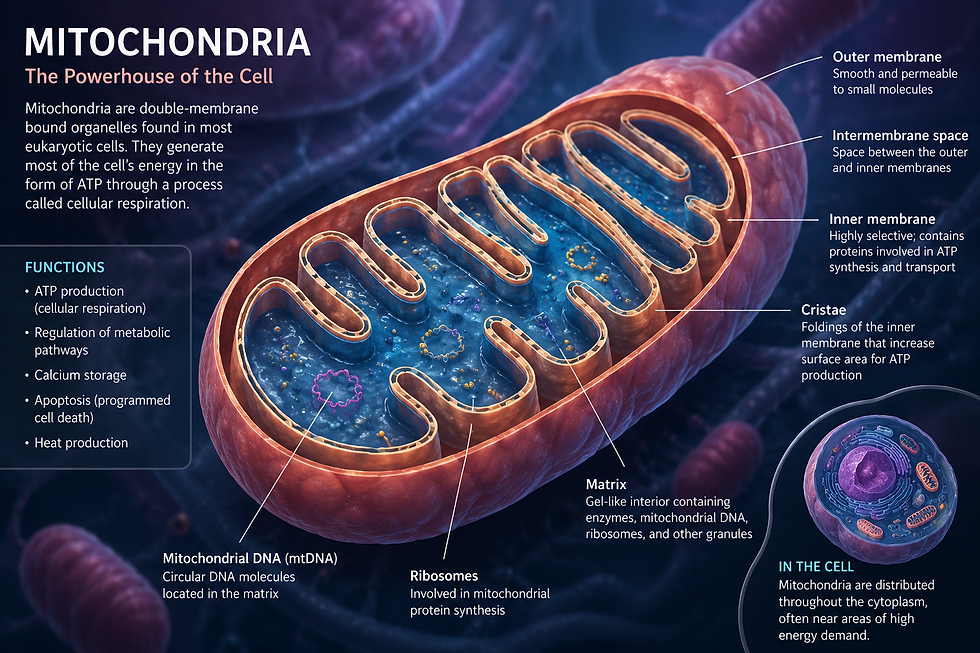
To understand why creatine matters beyond the gym, you need to understand mitochondria. These tiny power plants inside cells are the primary sites of ATP production through oxidative phosphorylation, a process that converts nutrients from food into usable cellular energy. Mitochondria are also central to calcium regulation, steroid hormone synthesis, immune signaling, and apoptosis (programmed cell death).
When mitochondria are dysfunctional, whether from aging, inflammation, infection, hypoxia (low oxygen), toxins, or genetic mutations, energy production falters across every system that depends on it. The result can manifest as fatigue, brain fog, metabolic dysfunction, hormonal imbalance, poor immune response, and impaired healing.
Research published in the Journal of Clinical Medicine highlights that "creatine supplementation has been reported to improve high-energy phosphate availability as well as have antioxidative, neuroprotective, anti-lactatic, and calcium-homeostatic effects." The same review notes that "CrM supplementation may have a role in improving cellular bioenergetics in several mitochondrial dysfunction-related diseases, ischemic conditions, and injury pathology and thereby could provide therapeutic benefit in the management of these conditions." Typical factors that lead to mitochondrial dysfunction include "hypoxia, inflammation, viruses, mutations, oncogenes, age, radiation, and carcinogens."¹
In other words, creatine doesn't just fuel muscles, it supports the body's fundamental energy infrastructure and serves as a valuable tool for supporting cellular resilience, protecting high-energy tissues, and helping the body adapt to the many stressors that impair mitochondrial health.
Blood Sugar Regulation and Metabolic Health
One of the most clinically relevant applications of creatine beyond exercise is its impact on blood sugar and metabolic health. A systematic review and meta-analysis of randomized controlled trials published in Nutrients found that "creatine supplementation seems to be effective in decreasing glycemic levels and glycosylated hemoglobin [HbA1c] concentrations compared to placebo." Notably, "no difference was observed compared to metformin or glibenclamide with creatine, and all treatments were able to reduce blood glucose levels. No major adverse effects were observed."²
This is a striking finding.
Creatine’s ability to lower HbA1c levels was comparable to metformin or glibenclamide!
Creatine's ability to improve glucose metabolism likely relates to its role in mitochondrial energy production and its influence on GLUT-4 transporter activity, the mechanism by which glucose is taken up into muscle cells. When mitochondria function optimally, cells use glucose more efficiently, reducing chronic elevations in glucose and insulin that drive metabolic syndrome, type 2 diabetes, and cardiovascular disease.
For clients managing prediabetes, insulin resistance, or type 2 diabetes, creatine represents a safe, well-tolerated adjunct to dietary and lifestyle interventions.
Brain Health and Mental Function
The brain is one of the most energy-demanding organs in the body, consuming roughly 20% of total energy despite representing only 2% of body weight. It is therefore highly sensitive to mitochondrial dysfunction and ATP depletion.
Creatine's neuroprotective effects are well-documented. By maintaining ATP availability in neurons, creatine supports neurotransmitter synthesis, synaptic function, and cellular resilience under stress. Research has shown benefits in cognitive performance under sleep deprivation, traumatic brain injury recovery, and neurodegenerative conditions.
The anti-lactatic effect of creatine, its ability to buffer lactic acid accumulation, is also relevant to brain function. Excess lactate in neural tissue is associated with cognitive fatigue, anxiety, and impaired mental clarity. By supporting efficient energy metabolism, creatine may help maintain sharper thinking and a more stable mood.
Hormonal Health and Steroidogenesis
Mitochondria are not just energy factories; they are also the initial site of steroid hormone synthesis. Research published in Frontiers in Endocrinology explains that "mitochondria play an important role in the synthesis of steroid hormones, including the sex hormone estrogen" and that "mitochondria are not only the initial site of steroidogenesis, but also use sex steroid hormones as modulatory factors for their own function and gene transcription."³
This bidirectional relationship means that mitochondrial dysfunction can impair hormone production, and hormonal imbalances can, in turn, worsen mitochondrial function.
Supporting mitochondrial health with creatine may therefore have downstream benefits for hormonal balance, including estrogen, testosterone, cortisol, and DHEA, though this area warrants further clinical research.
Immunity and Healing
Immune cells are energetically expensive. Mounting an immune response, whether against infection, injury, or chronic inflammation, requires rapid ATP production. Mitochondrial dysfunction impairs immune cell activation, proliferation, and resolution of inflammation.
Creatine's role in maintaining high-energy phosphate availability supports immune cell function and may accelerate tissue repair following injury or illness. Its antioxidative properties also help neutralize reactive oxygen species generated during immune activation, reducing collateral cellular damage.
For individuals recovering from illness or surgery, or those with chronic inflammatory conditions, creatine's support of cellular energy and antioxidant defense may be clinically meaningful.
Exercise Performance: Still Worth Mentioning

While this blog focuses on creatine's broader applications, its performance benefits remain well-established and relevant. Research confirms that "creatine monohydrate supplementation has been reported to safely improve high-intensity exercise performance by 10–20%, leading to greater training adaptations."¹
This matters beyond aesthetics. Muscle mass is a primary determinant of metabolic rate, insulin sensitivity, and functional longevity.
Preserving and building lean muscle through resistance training, supported by creatine, is one of the most powerful interventions for long-term metabolic and cardiovascular health.
Safety Profile
Creatine monohydrate has one of the most extensively studied safety profiles among dietary supplements. Decades of research across diverse populations, including children, older adults, and clinical patients, have consistently shown it to be safe and well-tolerated at standard doses (3–5 g/day for maintenance; 20 g/day in divided doses for short-term loading).
The most common side effect is mild gastrointestinal discomfort, typically resolved by taking creatine with food or reducing the dose.
One important clinical note: Creatine supplementation can increase serum creatinine, a standard marker of kidney function measured on routine metabolic panels. This alone is not a sign of kidney damage; it reflects increased creatine turnover. However, it can falsely suggest impaired kidney function on labs. If you are having routine bloodwork drawn, discontinue creatine supplementation approximately 2 weeks beforehand to allow creatinine levels to return to normal, and inform your clinician that you supplement with creatine.
Practical Guidance
Who may benefit from creatine supplementation:
Adults seeking to support metabolic health and blood sugar regulation
Those managing or preventing type 2 diabetes
Individuals with mitochondrial dysfunction or chronic fatigue
Adults looking to preserve muscle mass and metabolic rate with aging
Anyone supporting brain health, cognitive function, or mood
Athletes and active individuals seeking performance and recovery support
People recovering from illness, injury, or surgery
Dosing:
Maintenance: 3–5 g/day of creatine monohydrate
Loading (optional, for faster saturation): 20 g/day in 4 divided doses for 5–7 days, followed by maintenance dosing
Take with food or a carbohydrate-containing meal to support uptake
Adequate hydration is important
Form: Creatine monohydrate is the gold standard, most studied, most affordable, and most effective. Avoid proprietary blends with unnecessary additives.
Lab consideration: Discontinue 2 weeks before routine bloodwork to prevent false elevation of serum creatinine.
The Bottom Line
Creatine monohydrate is one of the most evidence-backed, safe, and versatile supplements available. Its benefits extend far beyond athletic performance, reaching into metabolic health, blood sugar regulation, brain function, hormonal balance, immunity, and cellular resilience. At the root of these wide-ranging effects is a single mechanism: supporting mitochondrial energy production.
In a world where mitochondrial dysfunction is increasingly recognized as a driver of chronic disease, creatine deserves a place in the functional nutrition toolkit, not just for athletes, but for anyone seeking to optimize cellular health and long-term vitality.
As always, work with your clinician to determine whether creatine is appropriate for your individual health history, goals, and current medications.
Sources:
Jimenez-Gutierrez GE, Martínez-Gómez LE, Martínez-Armenta C, et al. "Molecular Mechanisms of Creatine in the Context of Mitochondrial Dysfunction: Role of Creatine Supplementation in Disorders Involving Mitochondrial Dysfunction." Journal of Clinical Medicine. 2022;11(4):945. https://pmc.ncbi.nlm.nih.gov/articles/PMC8838971/
Gualano B, Rawson ES, Candow DG, Chilibeck PD. "Creatine supplementation in type 2 diabetic patients: a systematic review of randomized controlled trials." Nutrients. 2022. PMID: 34931982. https://pubmed.ncbi.nlm.nih.gov/34931982/
Bhatt DL et al. "Mitochondria as the Target for Disease-Related Hormonal Dysregulation." Frontiers in Endocrinology. 2021. https://pmc.ncbi.nlm.nih.gov/articles/PMC8554460/


Comments